
Si vis pacem para pacem
"If you want peace, prepare for war". This idea, voiced millennia ago, remains the guiding principle of foreign policy for major world powers. But what if we prepare for peace instead?

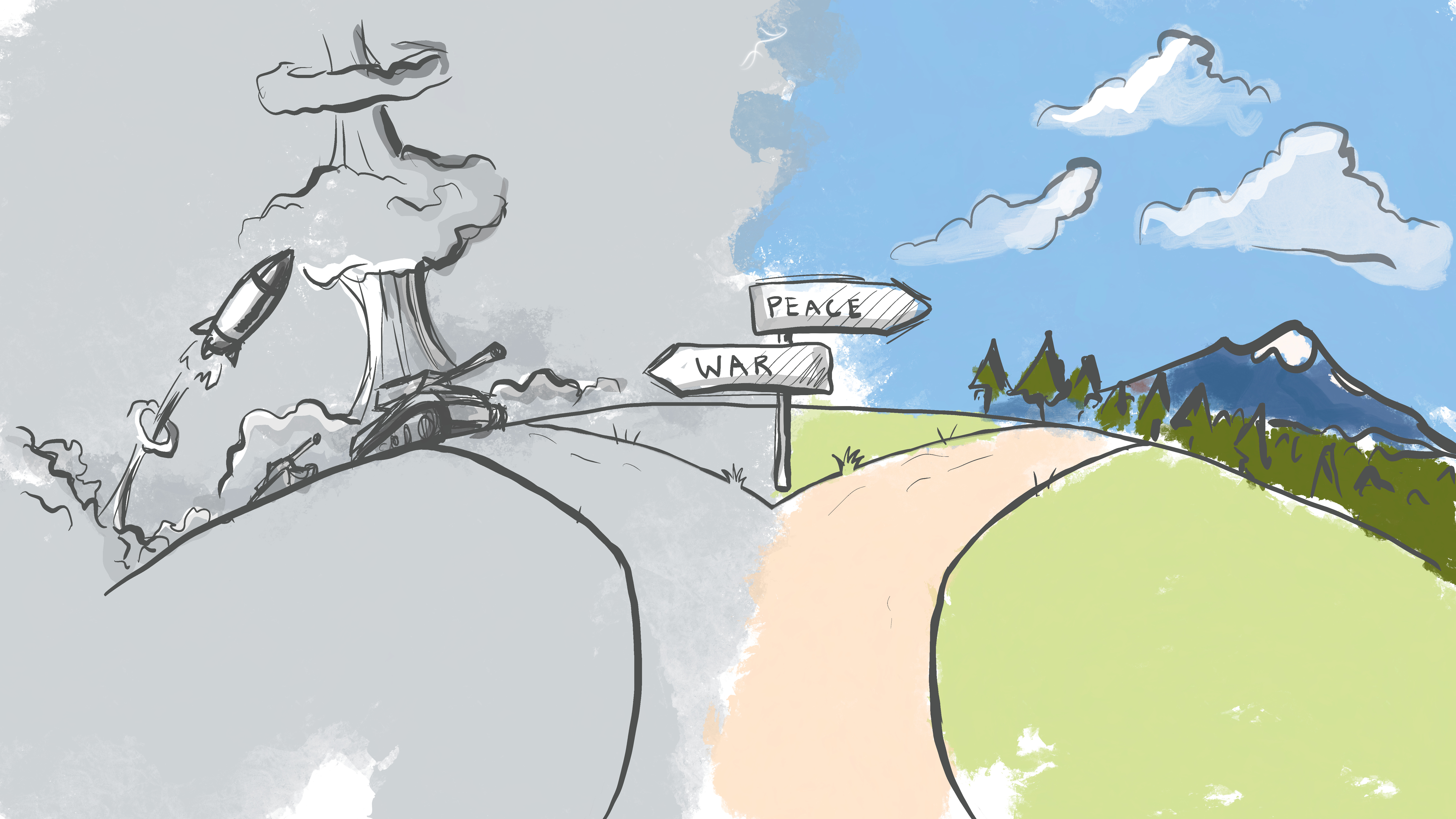
"If you want peace, prepare for war". This idea, voiced millennia ago, remains the guiding principle of foreign policy for major world powers. Only 16 out of almost 200 countries in the world do not have their own armies. But the number of people who live in those no-army countries represents less than 0.09% of the world population. In one form or another, the world we live in is para bellum, that is, preparing for war. But what if we prepare for peace instead and have a para pacem vision of the future?
War is a priority, poverty is not
According to the Global Peace Index in 2023, global military expenditure totaled $8.4 trillion. Just for comparison, economist Jeffrey Sachs claims that only $175 million per year is needed for a complete victory over poverty.
Here's what we can do to change the world, right now, to a better ride: Take all that money that we spend on weapons and defense each year and instead spend it feeding and clothing and educating the poor of the world, which it would many times over - not one human being excluded - and we could explore space, together, both inner and outer, forever, in peace. — Bill Hicks
However, alleviating poverty doesn’t seem to be a priority now, because in 2024, against the backdrop of Russian-Ukrainian, Israeli-Palestinian, Ethiopian, and other military conflicts, of which there are more than 50 on the planet now, military spending continues to grow.
Peace is not the default, war is
As Dan Williams aptly notes in his post "Why do people believe true things?", wealth is not the default state of humanity, poverty is, and truth is not the default, ignorance is. Following this idea, we can confidently say that peace is not the default, war is.
Human history is essentially a logbook of wars. As an illustration, shortly before the Spanish arrived in Americas, the Inca Empire had recently concluded a civil war over succession. In the Caribbean region, the Caribs frequently raided the more peaceful Arawaks. In the northeast, the Iroquois fought with the Hurons. And the Aztecs, it seems, were in conflict with virtually everyone they encountered.
War is father of all and king of all. Heraclitus
In other words, if we leave things "as they are", sooner rather than later, another war will occur. And another one. Since we now have much more powerful weapons than in Aztec times, each subsequent war threatens to be the last for humanity. Simply because after it, there will be no one left to wage war.
War not here, war not now
Apparently, we are living in a war-based civilization, where almost every state is ready to deploy its armed forces at the first whistle. Today's peace looks like this: it is either "War Not Here" or "War Not Now". Just think about it: if you live in a peaceful place, it's either because it's a piece of land without useful resources, or because an entire military-industrial complex is working to protect this peace in this limited area of land.
People sleep peaceably in their beds at night only because rough men stand ready to do violence on their behalf. George Orwell
This localized state of peace, which allows people to do business, create families, and walk their dogs in the park, is provided by an army ready to kill to maintain this status. Moreover, under the pretext of maintaining peace in your territory, this same army can bring death and war to other people somewhere on the other side of the world.
Tertium non datur?
Someone might say "What can you do? That's life! If you want peace, prepare for war, there's no other option." But we see that this approach doesn't create conditions for peace. With this approach, war is only a matter of time.
When you play the Game of Thrones, you win or you die. There is no middle ground.
Haven't we grown tired of playing the Game of Thrones? Haven't we as a civilization already gone through enough War-Plague-Famine cycles to finally try to break this vicious circle? Maybe if si vis pacem para bellum doesn't work, it makes sense to try si vis pacem para pacem?
Negative vs. Positive Peace
Most people understand the state of peace simply as the absence of war. But peace researchers divide peace into two types:
Negative peace, defined by the absence of war and violence
Positive peace, defined by a more lasting peace in a society that is able to absorb shocks without falling into conflict.
Personally, as someone who fled from war to the other side of the world, it's hard for me to imagine that positive peace is even possible, and yet we must try. Because until we see positive peace at least in our imagination, there's no point in thinking about its implementation in reality.
Conditions for Perpetual Peace
In 1795, Immanuel Kant attempted to formulate the conditions under which Positive Peace, or Perpetual Peace, as the philosopher himself called it, would be possible.
Kant, who, by the way, never left his native Königsberg and never saw the world with his own eyes, proposed the following conditions for establishing perpetual world peace:
"No secret treaty of peace shall be held valid in which there is tacitly reserved matter for a future war"
"No independent states, large or small, shall come under the dominion of another state by inheritance, exchange, purchase, or donation"
"Standing armies shall in time be totally abolished"
"National debts shall not be contracted with a view to the external friction of states"
"No state shall by force interfere with the constitution or government of another state"
"No state shall, during war, permit such acts of hostility which would make mutual confidence in the subsequent peace impossible: such are the employment of assassins (percussores), poisoners (venefici), breach of capitulation, and incitement to treason (perduellio) in the opposing state"
Game theory eats peace for lunch
Obviously, Immanuel Kant knew nothing about Game Theory, which was developed by John von Neumann and Oskar Morgenstern 250 years after he presented his ideas on perpetual / positive peace. Unfortunately, in a world where Realpolitik is the main way of conducting business in the international arena, the feasibility of each of the proposed points raises great doubts.
In 2024, point #5 from this project is observed even less than ever before, because now states interfere in each other's affairs not only physically but also digitally. As for the poisoners from point #6, literally this month Vladimir Putin got his personal hitman back in exchange for hostages, as he did in the past with his domesticated war lord Vladimir Bout and others.
And #3 is even less feasible. The attempt by Reagan and Gorbachev to curb the nuclear arms race did not lead to significant results, let alone the idea of disbanding standing armies. Any state that would choose to comply immediately becomes vulnerable to the one that won't. The game theory eats perpetual peace for lunch.
Si vis pacem para pacem
Since the rulers are the ones who get profits from the war, they use all the propaganda might they have to indoctrinate this si vis pacem para bellum approach. In one form or another, they will feed our consciousness with hatred towards some enemy against whom we must unite. They will continuously run Hate Weeks and Two Minute Hate, just to keep us aligned.
The horrible thing about the Two Minutes Hate was not that one was obliged to act a part, but, on the contrary, that it was impossible to avoid joining in. George Orwell, "1984"
That's why it's so important to prepare for peace. The more we imagine peace, and not just Negative Peace, but also Positive Peace, the sooner we will see how much we lose as a society by agreeing to war.
The para pacem vision is needed as a starting point, a benchmark, a reference to compare the real with the possible. So that we can always assess the current para bellum state of affairs against how it could be if we were preparing for peace instead of war.
The para pacem vision will help more people see the fact that any politician calling them to war is actually inviting them into a deal where they will pay with their lives, while he and his circle will profit in dollars.
Imagine for a moment a world in which, without the need to constantly prepare for war, $8.4 trillion suddenly became available for investment. Where could we invest it? In science, education, infrastructure, healthcare, art, finally! Oh, how much good we could do if we didn't need to prepare for war!
Critical thinking and planetary worldview
Preparing for peace doesn't mean naively disarming in a hostile world. Rather, it involves investing in education, cross-cultural understanding, and bringing up a generation of Planetary Humans who would perceive any politician or public figure proposing to start a war not as a savior of the nation, but as a psychopath who has no right to hold leadership positions in power.
Developing critical thinking skills will help us resist the power of today's technologies that create unprecedented conditions for propaganda and disinformation. And cultivating a holistic worldview will help us recognize how interconnected our world is, and that with so many planetary challenges, we simply cannot afford to waste resources on wars that enrich the few and devastate the lives of the many.
The choice between preparing for war or preparing for peace is ultimately a choice about what kind of future we want to create. Only by preparing for peace can we hope to achieve it.
P.S.
This P.S. stands for Practical Steps, not Post Scriptum.
I'm sitting right now in the reading room of the Mariano Moreno National Library of Argentina, finishing this post, but I have one big critique of this and similar texts, which can be summed up as follows:
"Everything is stated correctly, and I agree with this position, but I have absolutely no idea what I can personally do to contribute to the creation of a Positive Peace."
Actually I have an idea for a solution, but this calls for another post! If we want to stop the wars, we need to make those in charge accountable for peace.
I've just discovered these two letters, that I didn't know about at the time. Will leave the links here:
https://courier.unesco.org/en/articles/why-war-letter-albert-einstein-sigmund-freud
https://courier.unesco.org/en/articles/why-war-letter-freud-einstein